
What is TTDI?
TDDI: what it actually means, and why we wrote this guide
We talk about TDDI a lot at Carelink. It stands for Treatment of Disease, Disorder or Injury, and it’s one of the regulated activities we’re registered for with the Care Quality Commission (CQC). Over the years, we have begun to realise that for many it can be confusing, a mouthful, and it often a very clinical term.
Between us, we’ve spent around 40 years in nursing, including in intensive care, and we’ve worked with a lot of people who needed exactly this kind of care at home but haven’t heard of TDDI.
We know that when families first come across “TDDI” on a website or in a discharge letter, the word doesn’t really tell them anything useful. It doesn’t tell them what someone will actually do for their dad. It doesn’t tell them how their mum will be kept safe. Additionally, it doesn’t tell a case manager or a discharge nurse whether the provider in front of them is the best fit or whether they can genuinely deliver what their patient needs.
So, we wrote this guide with the aim of putting TDDI into language that makes sense for the people we’re caring for, for their families, not forgetting the professionals – I.e., NHS teams, local authority commissioners, and case managers we work alongside.
What is TDDI?
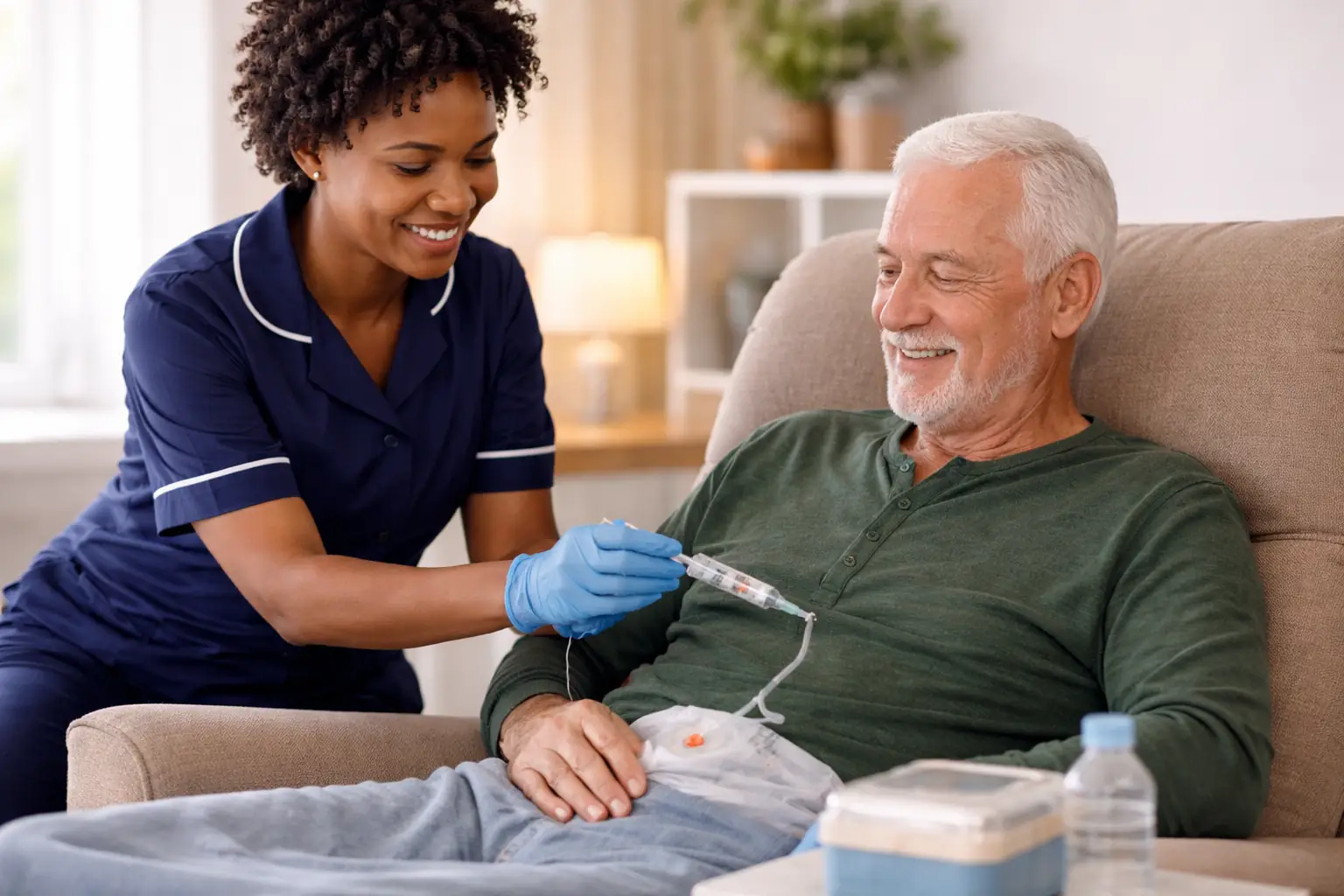
TDDI stands for Treatment of Disease, Disorder or Injury. In plain English, it’s the care and clinical support given to someone to help manage, treat, or reduce the effect of an illness, a long-term condition, or an injury, delivered in their own home, rather than in hospital.
It’s a regulated activity, which means a provider must be specifically registered with the CQC to deliver it. Most domiciliary home care agencies aren’t, because TDDI involves clinical tasks that go beyond standard personal care. Things like ventilation support, tracheostomy care, PEG feeding, catheter care, or seizure management need professional oversight to be done safely. The providers who can offer TDDI tend to be nurse-led for that reason.
That’s the formal explanation. Here’s what TDDI actually looks like in practice. We’ve broken it down into the three things it really covers.
1. Treatment
This is the day-to-day work of managing a person’s condition properly.
That means:
- Care plans that are written for the actual person, not copied from a template -and that get updated when things change
- Medication given at the right time, in the right way, and accurately recorded
- Staff who follow national clinical guidance, for example from the National Institute for Health and Care Excellence (NICE)
An example is if we have someone living with diabetes who receives their medication on time. Their blood sugar is monitored and recorded properly. If something looks unusual, it’s flagged and acted on, not left until somebody happens to look at the notes next week.
2. Managing the condition
This stage is about stopping things from getting worse and spotting trouble early. It involves:
- Keeping a close eye on long-term conditions such as diabetes, dementia, COPD, Parkinson’s, or heart failure
- Supporting nutrition and hydration – which sound simple but are quietly important
- Infection prevention – proper handwashing, PPE where it’s needed, clean equipment
- Picking up small changes early – a new cough, less appetite, a wound starting to look different
A lot of avoidable hospital admissions can take place because something small wasn’t noticed in time. The point of having clinical eyes on someone regularly is so that these small things are noticed and taken care of before any hospital admission.
3. Injury prevention and care
Injury prevention and care is the section concerned with safety. People with complex needs are often at higher risk of falls, pressure sores, choking, or accidents involving equipment they rely on. So we look at:
- Risk assessments – falls, mobility, skin integrity, swallowing, equipment use
- A safe home environment, and equipment that’s used correctly
- Recording and reporting incidents honestly, so we can learn from them
- Safeguarding procedures, applied properly whenever something doesn’t feel right
A common example is if someone has a fall, staff provide first aid, the incident is recorded, and the care plan is updated to reduce the chance of it happening again. Maybe a rug needs to move. Maybe the timing of medication is contributing. Maybe a piece of equipment isn’t being used the way it should be. The point is that a fall isn’t just dealt with and forgotten. It tells us something, and we act on it.
Why TDDI is important in home care
Treatment of Disease, Disorder or Injury is important because it allows people, even those at higher risk, to stay at home, safely, when otherwise they would struggle to do so
When TDDI care at home is done well, it means:
- People can live in familiar surroundings, with the family and friends they love nearby
- Independence is supported, not chipped away
- Hospital admissions can be reduced because problems get spotted early, medication is right, and infections are prevented
- The risk of hospital-acquired infections, medication errors, and avoidable injuries goes down
- Families can breathe a little
A lot of the families who get in touch with us have been carrying complex care on their own, often for months. They’re exhausted and worried about getting it wrong. They might have often tried home care that wasn’t quite up to the complexity of what their loved one needed, and they didn’t know who to call when things changed on a Saturday afternoon.
We don’t claim to know exactly what someone is going through because every situation is different, and the family always knows the person best. What we do is listen properly and bring clinical experience to whatever the picture is. We work with families, not around them.
How to get this service
If you think TDDI care at home might be what you or someone you love needs, the easiest first step is to get in touch. You can:
- Call us and speak to one of our team
- Request a free care assessment online, and we’ll call you back
There’s no pressure on the first call. We’ll ask the right questions, listen carefully, and be honest about whether we’re the right fit. If we’re not, we’ll usually be able to point you in the direction of someone who is.
We support people across:
- Sussex – including Worthing, Brighton & Hove, Chichester, Crawley, and the surrounding areas within roughly a 40-mile radius of Worthing
- Surrey – covering various parts of the county for home-based clinical care
Who actually delivers the care
This is the question we get asked most often, so it’s worth answering directly. CareLink Direct was founded by three nurses, all with intensive care backgrounds. We’re hands-on, and we’re on the ground, not sat in an office signing off paperwork from a distance. The clinical team supervises care plans, oversees high-risk procedures, and is involved in reviews. Day-to-day care is delivered by a trained workforce with the skills to match the needs of the people we support, and the supervision around them to keep things safe.
That blend matters. It’s what allows us to deliver TDDI properly, while also providing the personal care that often sits alongside it.
